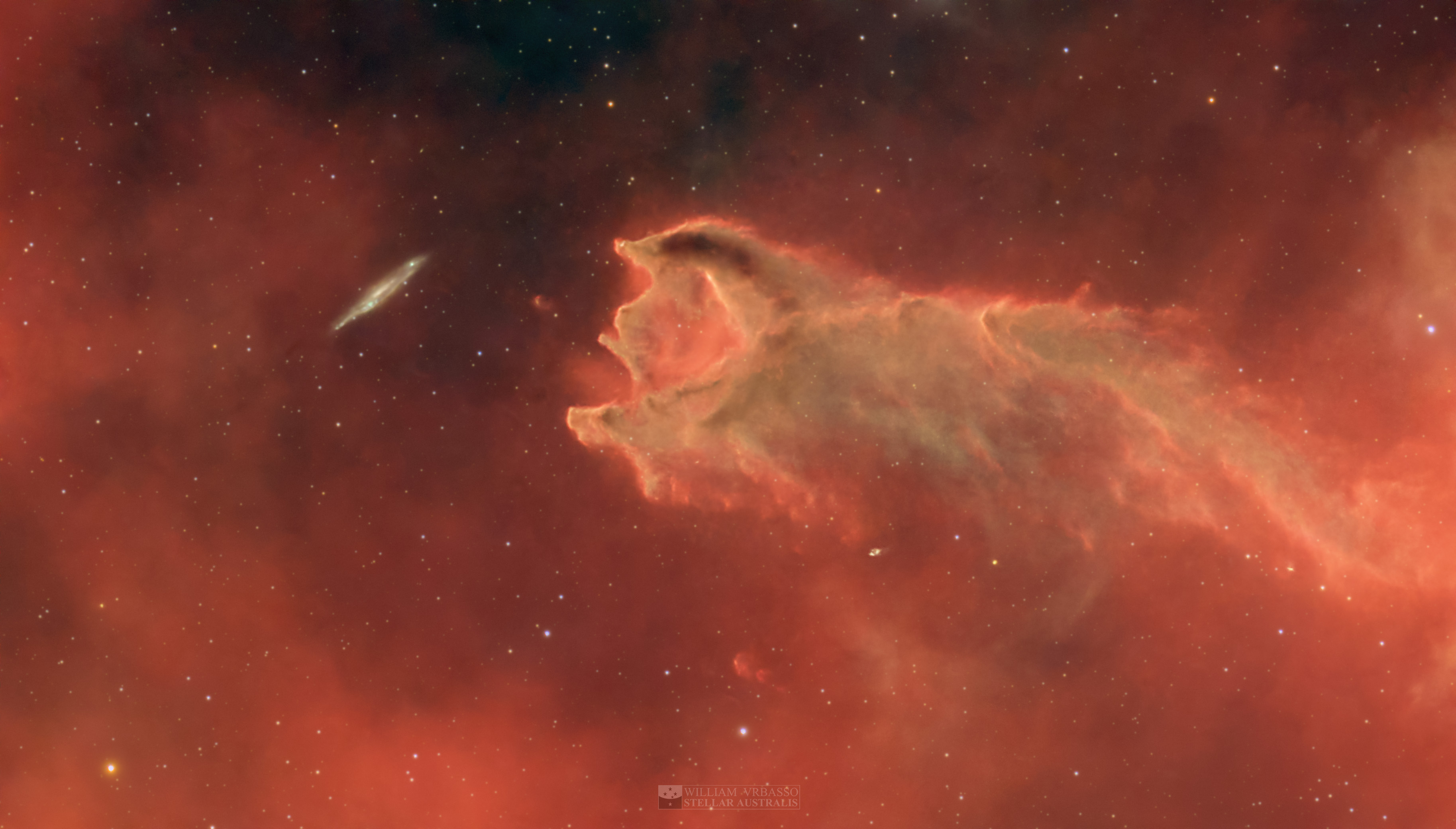
CG 4: The Globule and the Galaxy
Image Credit & Copyright:
William Vrbasso
Is this a cosmic monster ready to devour an unsuspecting galaxy?
Thankfully, that is not the case.
The red “monster” shown in the featured image is Cometary Globule CG 4, 1,300 light-years away in the Constellation Puppis.
CG 4 is a molecular cloud, where hydrogen becomes cold enough to form molecules that can be brought together by gravity to create stars.
The shape of CG 4 resembles that of a comet, but its head is 1.5 light-year in diameter and its tail is 8 light-years long; for comparison, the distance from the Earth to the sun is only 8 light-minutes.
Astronomers believe that the tail of a cometary globule could have been sh/day/ed by a nearby supernova explosion or by irradiation from hot, massive stars. Indeed, CG 4 and other nearby globules point away from the Vela Supernova Remnant, at the center of the Gum Nebula.
The edge-on spiral galaxy, ESO 257-19, is more than a hundred million light-years beyond CG 4, and is completely safe from the “monster”.